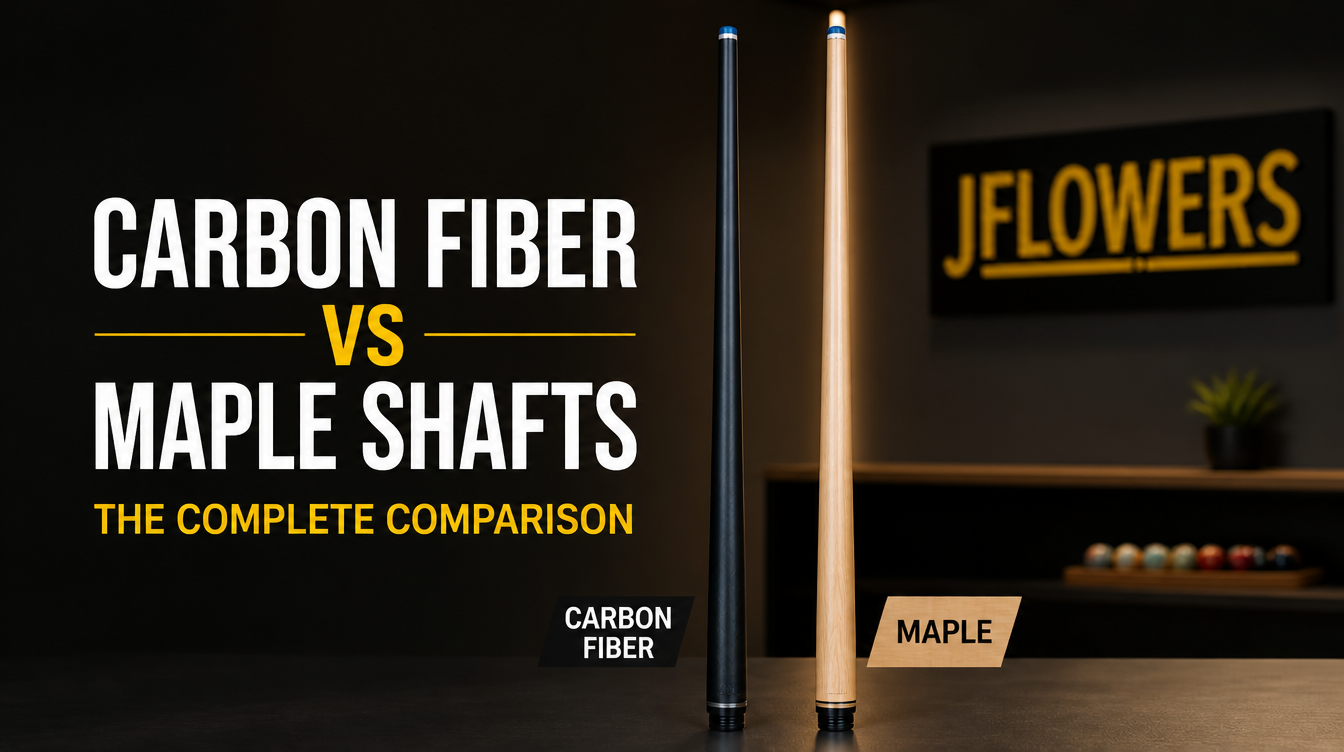
Carbon Fiber vs Maple Shafts: The Complete Comparison
JFlowers Cues
If you've been shopping for a new shaft, you've hit this choice: carbon fiber or maple? Both have passionate advocates. Both produce players who win at the highest levels. And both camps will give you a dozen reasons why theirs is the obvious choice.
Listen to this article
Head-to-head on every variable that actually matters
Here’s an honest comparison across every variable that actually matters — no brand loyalty, no marketing spin, just what each material does well and where it falls short.
The Basics: What Each Material Is
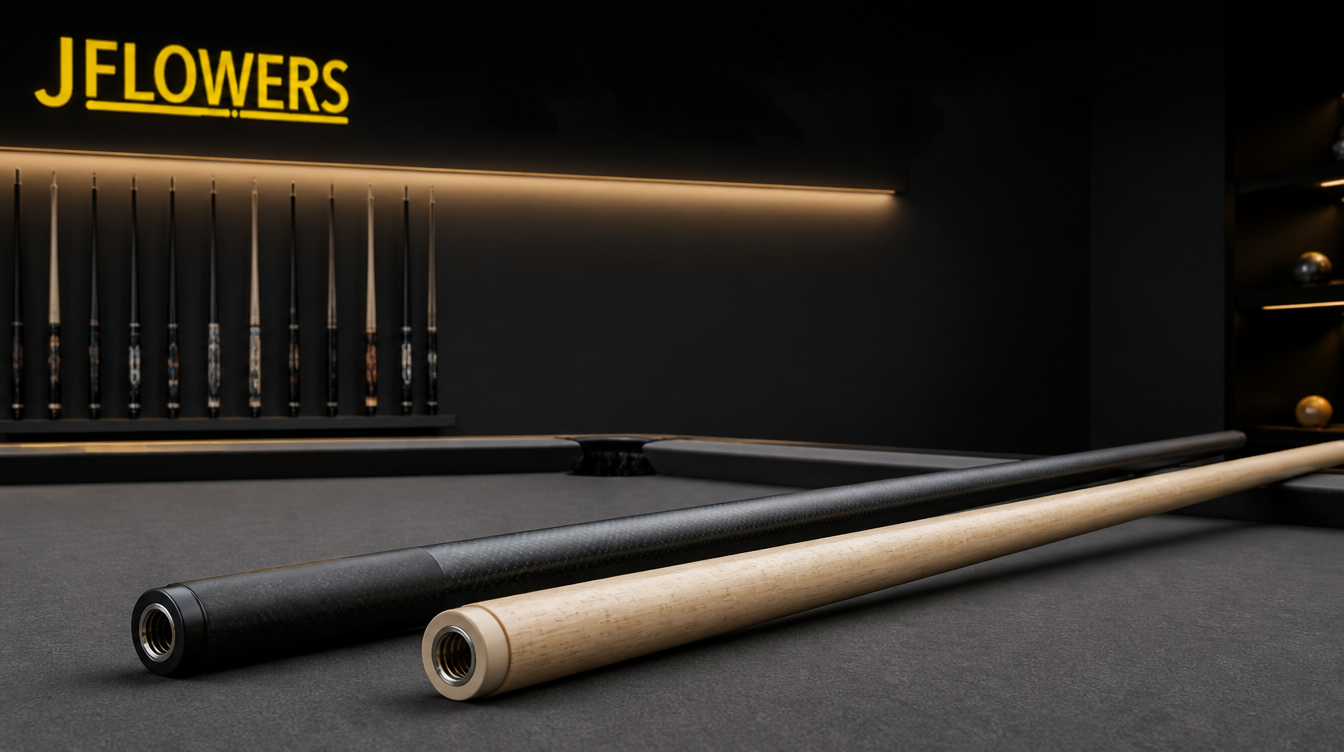
Maple Hard rock maple has been the dominant shaft material in pool for over a century. It’s selected from billets for grain consistency, density, and stiffness, then precision-tapered from tip to joint. A quality maple shaft from a reputable manufacturer is a precisely engineered piece of wood — not just a stick. The best maple shafts are carefully dried, selected for straightness, and tapered to tight tolerances.
Carbon Fiber Carbon fiber shafts are built from layers of carbon fiber composite material around a core — typically foam, hollow, or composite. The construction is engineered to optimize stiffness, weight distribution, and how the shaft responds on contact. The manufacturing is more controlled than wood — every shaft comes out of the same process, without the natural variation that affects every piece of wood.
Deflection Deflection is the amount the cue ball veers off the aim line when you apply side spin. It’s one of the most practically important performance variables in pool.
Carbon fiber wins this category clearly. The material’s light weight and high stiffness produce lower deflection than both standard maple and engineered low-deflection maple shafts. The result: when you apply english, the cue ball stays closer to your natural aim line. Less compensation required.
Quality low-deflection maple shafts narrow the gap significantly. The best maple low-deflection options perform at a very high level — but carbon fiber still leads in consistency, especially across different conditions.
Winner: Carbon fiber — lower baseline deflection and more consistent deflection across conditions.
Environmental Stability (Warping)
Wood responds to its environment. Humidity makes wood fibers expand; dryness makes them contract. Repeated cycles of this — or a sustained period in a humid environment — can produce a warp in a maple shaft. Even players who store their cues carefully often deal with minor warp issues at some point.
Carbon fiber is immune to this. Leave it in a humid car, store it in a garage through temperature swings, take it from a climate-controlled room to an outdoor event — it plays the same every time. This is one of the clearest, most practical advantages carbon fiber has over maple. Winner: Carbon fiber — completely immune to environmental warping.
Feel and Feedback This is where maple holds an edge — for many players, at least. A quality maple shaft on contact transmits a warm, tactile feedback that many players describe as feeling more alive or connected. Soft shots and delicate position play often feel more natural on maple for players who grew up on the material.
Carbon fiber transmits a different feel — crisper, more direct, sometimes described as slightly harder. Ferrule technology has narrowed this gap considerably over the last several years, and many carbon fiber shafts are specifically engineered to produce a warmer hit feel. But the gap hasn’t fully closed for all players.
Winner: Maple (for most players) — warmer, more traditional feel, especially on delicate shots.
Break-In Period Maple shafts need to be broken in. A new maple shaft plays differently in the first few sessions than it does after it’s been used for a month or two. The wood settles, the oils from your hands condition the surface, and the shaft develops what players call “feel.” This is a real phenomenon — new maple shafts often play a bit stiffer and less responsive than the same shaft after break-in.
Carbon fiber has no break-in period. The shaft plays the same on session one as on session five hundred. What you buy is what you get, immediately and consistently.
Winner: Carbon fiber — no break-in, instant and permanent consistency.
Maintenance Maple requires real maintenance. The shaft surface needs to be kept clean — chalk and skin oils accumulate and affect the feel. Periodic burnishing or light sanding restores the surface. Proper storage is critical. Players who ignore maple shaft maintenance end up with shafts that feel wrong and perform inconsistently.
Carbon fiber needs almost none of this. Wipe it down with a damp cloth occasionally. Keep the tip maintained. Store it in a case. That’s it. For players who don’t want to think about shaft maintenance, this is a significant practical difference.
Winner: Carbon fiber — minimal maintenance compared to maple.
Durability and Lifespan A well-maintained maple shaft from a quality manufacturer can last many years. But wood ages — it develops surface wear, the feel changes over time, and at some point the shaft needs replacing. Environmental factors accelerate this process.
A quality carbon fiber shaft can realistically last a decade or more with proper care. The material doesn’t degrade the way wood does, doesn’t warp, and doesn’t accumulate wear in the same way. For players who want to buy once and not think about it for years, carbon fiber has a clear durability advantage.
Price Quality maple shafts are available at a lower entry price point. A solid low-deflection maple shaft from a quality manufacturer can be found in the $150–$250 range. Quality carbon fiber starts higher — roughly $200–$250 at the entry level, $250–$450 in the quality mid-range, and $450–$800+ at the premium tier.
When you factor in replacement cycles, the long-term cost difference narrows. But the upfront investment is higher for carbon fiber — that’s just reality.
Winner: Maple — lower upfront cost. Carbon fiber may be competitive on long-term cost-per-year.
Consistency Across Sessions Maple shafts vary slightly based on conditions — a humid day, a warm room, how long since the shaft was cleaned. These variations are often small, but they exist. Over the course of a long tournament day, a maple shaft may feel slightly different in the morning versus the evening.
Carbon fiber doesn’t vary. Session to session, morning to evening, home practice to tournament — the shaft behaves identically. For competitive players who need their equipment to be a constant, this reliability is one of the strongest arguments for carbon fiber.
Winner: Carbon fiber — genuinely identical performance across all conditions.
Summary Scorecard
Deflection: Carbon fiber
Environmental stability: Carbon fiber
Feel and feedback: Maple (for most players)
Break-in period: Carbon fiber (no break-in needed)
Maple is still the right choice for a meaningful portion of players:
Players with a strong preference for the traditional feel of wood who’ve tried carbon fiber and genuinely don’t prefer it
Players on tighter budgets who want quality performance without the premium carbon fiber price
Players in controlled environments where storage is always consistent and warping isn’t a concern
Players who enjoy the break-in process and the way a maple shaft develops character over time
Who Should Choose Carbon Fiber?
Players who want consistent performance without maintenance overhead
Players in humid, hot, or variable climates where wood warping is a real-world concern
Players who travel frequently and can’t control storage conditions
Intermediate and advanced players applying regular english who want more predictable deflection
Players who want to buy a shaft once and still be using it a decade later
The Adjustment Period: What Maple-to-Carbon Switchers Experience
Almost every player who switches from maple to carbon fiber goes through an adjustment period — typically 2–4 weeks of regular play. The reason is mechanical: your aim compensation for your old shaft’s deflection profile was trained over thousands of shots. The lower deflection of carbon fiber makes that compensation too much — your english shots miss slightly in the opposite direction from where you used to miss. This passes. After recalibration, most players find the lower deflection makes their english shots feel more natural. The number of players who switch and then go back to maple is small — most who give it a real trial period end up preferring the carbon fiber.
Can a maple shaft ever outperform a carbon fiber shaft? On individual shots and in individual sessions, yes — especially for players who prefer the feel of maple and have fully developed their technique on it. The material advantage of carbon fiber shows up most clearly in consistency across conditions and time, not necessarily in any single shot. Do professionals still use maple shafts? Yes — a significant number of professional players still use quality maple shafts. Some are under sponsorship agreements; others simply prefer the feel. The presence of maple at the professional level is a legitimate argument for its performance ceiling. Is there a maple shaft that matches carbon fiber for deflection? Quality low-deflection maple shafts narrow the gap significantly. The best maple low-deflection options perform at a very high level. Carbon fiber still leads, but the best maple isn’t far behind. Can I switch back to maple after using carbon fiber? Yes — and some players do. The adjustment period going back exists for the same reason as going to carbon fiber: you have to recalibrate your deflection compensation. Most players can switch back within a similar timeframe.
Final Thoughts
Carbon fiber wins the majority of measurable performance categories — deflection, stability, consistency, durability, maintenance. Maple wins on feel (for many players) and upfront price.
The right choice depends on which of those factors matter most to you. If feel is your primary priority and you’ve tried carbon fiber and don’t prefer it, maple is a completely legitimate high-performance choice. If consistency, low deflection, and low maintenance are your priorities, carbon fiber makes a strong case.
The best approach if you’re genuinely undecided: find a way to shoot with both before committing. Your hands will often give you a clearer answer than any comparison article can.
After comparing JFlowers to Predator, Mezz, McDermott, Meucci, Jacoby, Pechauer, and a dozen more brands across every price point and construction philosophy — the question that started all of it deserves a direct answer: which pool cue brand actually offers the best value for serious competitive players in
2026?
Players Technology is one of the most widely used cue brands in American pool halls. Their two-piece cues at $40-$150 have introduced millions of American players to personal cue ownership. Nearly every serious pool player in America either started on a Players cue or played against someone who did. Comparing Players to JFlowers isn’t really a direct competition — it’s a marker on the journey from beginner to serious competitor.